Connecting Samoa’s infrastructure ambitions with proven Chinese lifting engineering.
Hangzhou Anugenix Lift Co., Ltd. is a professional Aerial Work Platform Manufacturer specializing in the design, production, and supply of boom lifts, scissor lifts, mast lifts, and comprehensive access equipment solutions for global markets. Located in Hangzhou, China, the company is committed to delivering safe, reliable, and efficient lifting equipment widely used in construction, warehousing, maintenance, logistics, and industrial operations.

With a strong focus on innovation and engineering excellence, Anugenix Lift integrates advanced hydraulic systems, intelligent control technology, and high-quality structural components to ensure superior performance and durability. All products are manufactured under strict quality control systems and comply with international safety standards, providing stable operation in both indoor and outdoor working environments.
The company offers a full range of OEM and ODM services, allowing customization in specifications, load capacity, working height, and functional configurations to meet diverse customer requirements. Its experienced engineering and technical teams work closely with clients to deliver tailored solutions that enhance productivity and workplace safety.

Backed by a professional sales and after-sales support team, Hangzhou Anugenix Lift Co., Ltd. is dedicated to providing responsive service, reliable spare parts supply, and long-term technical support. The company continues to expand its global presence while striving to be a trusted partner in aerial work platform and access equipment solutions.

Four high-demand MEWP configurations shortlisted for harbour, resort and municipal works in Samoa’s Mulifanua region.

Why Samoa’s western gateway is becoming a genuine demand hub for mobile access equipment.
Mulifanua sits on the north-western tip of Upolu and is best known as the site of Faleolo International Airport and the Mulifanua ferry terminal — the principal sea link between Upolu and Savai’i. This dual role as an aviation gateway and a maritime chokepoint has created a concentrated cluster of construction, cargo handling, resort development, and public infrastructure activity that did not exist a generation ago.
The practical effect for equipment buyers is a market with high task diversity but low fleet density. Local contractors rarely maintain large dedicated MEWP fleets, so they rely on versatile, transportable machines that can move between an airport terminal refurbishment, a wharf lighting project, a beachfront resort build and a fuel depot maintenance job in the same fortnight. That is precisely the operating profile that mobile scissor lifts, self-propelled boom lifts and truck-mounted platforms are designed for.
Coastal salt-spray exposure, high humidity and tropical UV load also mean that corrosion protection, galvanized structural elements and sealed electrical systems are not optional extras in this market — they are baseline requirements. Suppliers who understand this environmental reality gain a measurable reliability advantage over generic catalogue exporters.
The macro forces shaping supply, specification and pricing for Pacific buyers.
Globally, the mobile elevated work platform sector has moved through a pronounced post-pandemic replacement cycle and is now entering a phase defined by electrification, telematics integration and safety-regulation harmonization. Fleet operators in mature markets are shifting capital from diesel boom lifts toward electric and hybrid scissor lift fleets, driven by urban emissions rules, indoor air-quality standards and total cost of ownership advantages in maintenance.
At the same time, manufacturing capacity has concentrated heavily in China, which now supplies a dominant share of the world’s scissor lifts and a rapidly growing share of boom lifts. For import-dependent markets like Samoa, this concentration is advantageous: competitive pricing, shorter lead times and a mature OEM/ODM ecosystem that can adapt machines to tropical and island operating conditions.
Three structural themes define the current global picture. First, safety regulation convergence: EN 280, ANSI A92 and ISO 16368 alignment is pushing manufacturers toward standardized guardrails, load-sensing and tilt protection. Second, electrification: battery-drive scissor lifts now represent the majority of new indoor-oriented orders. Third, digitization: fleet telematics, fault diagnostics and remote lockout are becoming standard expectations rather than premium add-ons.
Six directional forces every procurement team should factor into a five-year equipment plan.
Lithium battery packs replacing lead-acid, with fast-charge and opportunity-charging capability becoming standard on scissor and mast lifts.
Fleet dashboards reporting utilization, fault codes and battery health, enabling predictive maintenance even in remote island deployments.
Convergence toward ISO 16368 and EN 280 means load-sensing, tilt cut-out and secondary guarding become cross-market expectations.
Narrow-chassis scissor lifts and zero-tail-swing booms designed for tight resort, terminal and streetscape work zones.
Quick-attach accessories converting one base machine into a cargo lift, material handler or personnel platform, maximizing ROI per unit.
Hot-dip galvanizing, marine-grade coatings and IP-rated electrical enclosures tailored to salt-spray and high-humidity island environments.
Matching machine type to the real tasks buyers face along Samoa’s north-west corridor.
Equipment selection in Mulifanua is rarely about buying the biggest machine. It is about matching platform geometry, power source and transport footprint to a specific recurring task. The four scenarios below represent the majority of MEWP demand in the region.
A three-horizon view of how MEWP technology will evolve — and what it means for Mulifanua procurement.
Near term (0–3 years): The dominant shift is the mainstreaming of lithium-ion power across scissor and mast lift classes, paired with basic telematics. Expect CAN-bus control architectures, integrated battery management systems and diagnostic ports to become baseline rather than premium. For Mulifanua buyers, this translates into lower maintenance burden and better remote supportability.
Mid term (3–7 years): Semi-autonomous functions — automated levelling, envelope-limiting and anti-collision proximity sensing — will move from high-end boom lifts into mid-market scissor platforms. Remote diagnostics and over-the-air parameter updates will reduce the need for on-island specialist technicians, a decisive advantage for Pacific operators.
Long term (7–12 years): Full fleet-level autonomy in defined work zones, predictive maintenance driven by machine-learning models, and modular battery-swap architectures. Hydrogen fuel-cell range extenders may appear in heavy boom classes, though battery-electric is expected to dominate the scissor and mid-boom segments.

How export buyers can structure procurement for long-term cost and safety performance.
For institutional buyers — port authorities, airport operators, municipal works departments and large contractors — the value of a MEWP supplier is judged less on unit price and more on whole-life program support. A structured procurement approach typically involves four layers.
Anugenix Lift structures export programs around exactly these four layers, which is why the company invests equally in engineering customization and in after-sales infrastructure. For Mulifanua buyers, the practical outcome is a supplier relationship that survives the first delivery — and continues to add value across the machine’s ten-to-fifteen-year service life.


Eight additional export-ready configurations covering truck-mounted, suspended, rough-terrain, mast and high-reach scissor classes.


Battery-drive scissors, hydraulic scaffolds, high-reach booms and electric truck platforms — remaining portfolio options.


Direct answers to the questions export buyers from Samoa and the wider Pacific ask most often.
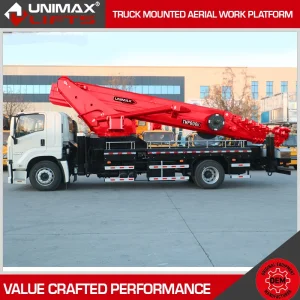
For coastal and airport work, electric-drive scissor lifts with corrosion-protected chassis dominate indoor terminal and resort fit-out tasks, while 18–20m boom lifts handle exterior façade and control-tower reach. Truck-mounted platforms are preferred for dispersed utility and wharf maintenance where rapid re-deployment matters more than maximum duty cycle.
Every export order is supported by a structured after-sales program: spare parts kits, maintenance schedules, remote diagnostic guidance and a dedicated technical escalation path. The company’s long-standing OEM/ODM relationships mean replacement components remain available throughout the machine’s service life.
Yes. OEM and ODM configurations include hot-dip galvanized structural elements, marine-grade paint systems, sealed IP-rated electrical enclosures and enhanced hydraulic filtration — all specified to extend service life in high-humidity, salt-laden island environments.
The portfolio spans working heights from roughly 6m to 60m across scissor, mast, boom and truck-mounted lift classes. Load capacities range from 300kg compact scissors up to heavy-duty truck-mounted platforms configured for multi-person plus tooling loads.
Production follows strict quality control systems aligned with recognized international standards including ISO 16368 and EN 280 principles, covering structural integrity, load sensing, tilt protection and guarding requirements. Certification documentation is provided per order specification.
Simply use the Send Inquiry Now link on this page. Share your task profile (working height, surface type, indoor/outdoor, load requirement) and the engineering team will return a specification recommendation, customization options and an export logistics outline.
Tell us your working heights, surfaces and site constraints — our engineering team will return a tailored configuration and export plan.
 Anugenix Lift


