China’s aerial platform industry has expanded rapidly, offering construction buyers more choices for lifting workers, tools, and materials. This guide examines China’s top 10 aerial platforms for construction buyers, including scissor lifts, boom lifts, vertical mast lifts, and truck-mounted platforms. Each category suits different working conditions. A compact electric scissor lift may fit through a warehouse doorway, while a diesel boom lift can reach over steel frames and uneven ground.
A practical question remains: what is the role of aerial platforms in construction? They provide controlled access to elevated work areas, helping crews install facades, inspect structures, maintain lighting, and complete mechanical work. The right machine can reduce ladder use, improve productivity, and support safer positioning. But equipment alone does not guarantee safe results. Operators need proper training, daily inspections, and site-specific planning.
This overview considers working height, platform capacity, outreach, power type, ground clearance, transport needs, and after-sales support. It also looks at certification documents, spare-parts availability, warranty terms, and manufacturer experience. Buyers should verify specifications directly with suppliers. Marketing data can be incomplete. A low purchase price may hide higher battery, tire, or maintenance costs.
No ranking is flawless. Site conditions change. A platform that performs well on a smooth factory floor may struggle on wet soil or steep terrain. The final decision should combine technical evidence, operator feedback, and a realistic ownership budget. Careful comparison matters more than a glossy brochure.
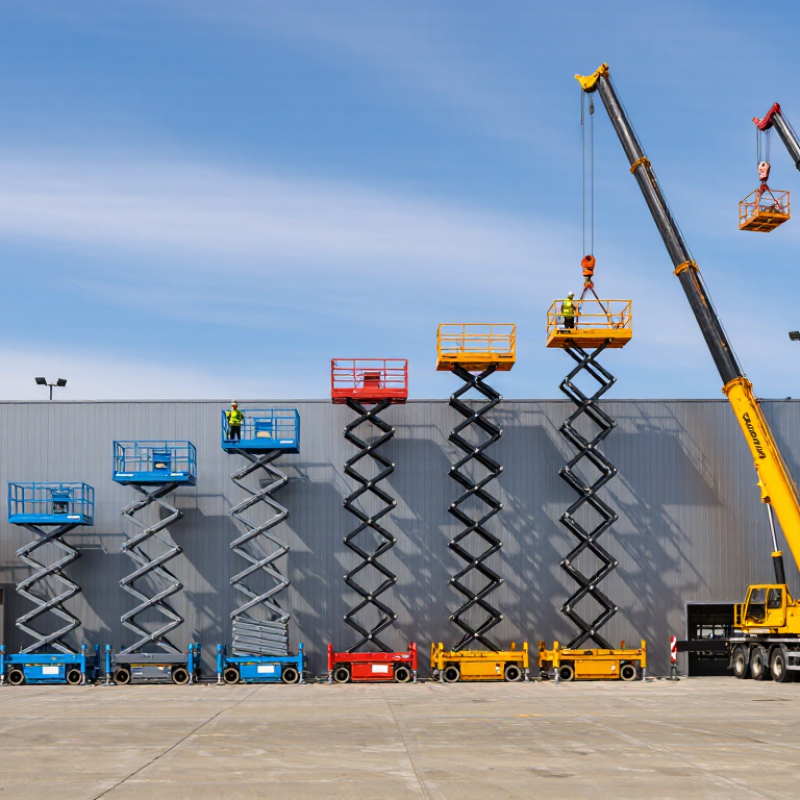
Aerial platforms are mobile machines designed to lift workers, tools, and limited materials to elevated work areas. Common types include scissor lifts, boom lifts, and vertical mast platforms. They support façade installation, lighting, steelwork, maintenance, and indoor fit-outs. Unlike ladders, they provide a guarded working deck, controlled height adjustment, and better access across large work zones.
Construction buyers need them when fixed scaffolding is slow, expensive, or unsuitable. A machine can position workers beside a twelve-metre wall, over machinery, or above uneven obstacles. However, height alone does not create safety. The International Powered Access Federation’s Global Safety Report 2024 recorded 118 powered-access fatalities in 2023 across participating countries. Falls, entrapment, and overturns remain serious risks. Selection must consider ground strength, wind limits, outreach, platform capacity, and emergency lowering systems.
Small details matter. Measure doorway widths before ordering. Check slab load ratings. Train operators on daily inspections and exclusion zones. The U.S. Bureau of Labor Statistics reported 1,069 construction fatalities in 2023, showing why access decisions deserve careful control. Aerial platforms can improve productivity, but buyers sometimes focus too heavily on rental price. That is a weakness. Transport, charging, maintenance, operator competence, and site delays can change the real cost. A careful buyer compares the platform’s working envelope with the actual task, not just its maximum height.
Aerial platforms lift workers, tools, and limited materials to elevated work areas. They support façade work, lighting, steelwork, maintenance, and indoor fit-outs. A guarded deck is safer than a ladder, but not automatically risk-free.
Common types include electric scissor lifts, rough-terrain scissor lifts, and articulated boom lifts. Telescopic booms provide long, straight outreach. Vertical mast, crawler, truck-mounted, trailer-mounted, mast-climbing, and suspended platforms serve specialized tasks.
Scissor lifts provide wide decks for workers, tools, and light materials. Boom lifts reach over pipes, beams, machinery, and other obstacles. Choose a scissor lift for vertical work. Choose a boom for side access.
No. Buyers must also check outreach, deck capacity, ground conditions, and available space. A machine reaching a twelve-metre roof may still fail beside a wall. Its deck might not hold the crew and tools.
Measure doorway widths, aisle space, ceiling height, and transport routes. Check slab load ratings and ground strength. Record slopes, obstacles, overhead lines, and wind exposure. Small measurements prevent expensive delivery problems.
Check the rated platform capacity on the load chart. Include workers, tools, and materials together. Capacity may change when the boom extends or the basket shifts. Leave some room. A crowded platform is a warning sign.
Operators should inspect tires, controls, guardrails, alarms, and emergency lowering systems daily. Use exclusion zones below elevated work areas. Confirm training and site authorization before operation. Height does not create safety.
Compare purchase or rental price with transport, charging, maintenance, training, and site delays. A cheaper machine may cost more during repeated setup problems. Lifecycle cost is more useful than price alone. I might still underestimate weather delays.
Rough-terrain platforms suit uneven outdoor ground and larger construction areas. Crawler platforms can reduce ground pressure on sensitive surfaces. Both may require more setup space and preparation. Check access carefully.
Focusing only on maximum height is a common mistake. The correct machine must match height, outreach, capacity, power source, and wind limits. Review inspection records and emergency procedures too. The tallest option is not always the right one.
Aerial platforms are essential construction machines that provide safe, elevated access for installation, inspection, maintenance, finishing, and material-handling tasks. The role of aerial platforms in construction is to improve worker reach, productivity, and job-site flexibility while reducing the need for temporary scaffolding. This overview introduces ten leading Chinese aerial platform types, including scissor lifts, boom lifts, vertical lifts, telescopic platforms, articulated platforms, truck-mounted units, spider lifts, mast lifts, compact crawler platforms, and personnel lifts.
These platforms differ in working height, lifting capacity, mobility, platform size, and suitability for indoor or outdoor projects. Buyers should evaluate safety systems, load limits, emergency controls, operator training, certifications, inspection records, and maintenance support. A practical comparison should also consider supplier reliability, customization, delivery terms, spare-parts availability, energy use, repair costs, and expected service life. Looking beyond the purchase price helps construction companies select equipment that delivers dependable performance and lower total ownership costs.

 Anugenix Lift